
Compassionate individual therapy grounded in graduate training from the National Institutes of Health and the University of Maryland.
If you’ve been feeling stuck, exhausted, or disconnected for weeks or months in Bethesda, you don’t have to keep pushing through it on your own. We’re Lindsey Hoskins & Associates, a counseling practice serving clients across Maryland and Virginia, and our Bethesda, MD individual therapy gives you a private place to work through whatever has been weighing on you. Our founder trained at the National Institutes of Health and the University of Maryland’s Center for Healthy Families. When you feel ready, request a complimentary phone consultation and tell us, in your own words, what brought you here.
Individual Therapy in Bethesda, MD
Individual therapy is one-on-one work between you and a licensed clinician. You set the direction. Together you look at the patterns, beliefs, and past experiences shaping how you feel day to day, and then you build practical ways to respond differently.
People come to us for all sorts of reasons. Some are managing anxiety or a low mood that won’t lift. Others are grieving, moving through a hard transition, or finally facing something they’ve carried for years. A few simply want to understand themselves better before the next chapter. You don’t need a diagnosis or a crisis to begin. If something in your life feels off and you want a steady person in your corner, individual counseling in Bethesda can help you find your footing again.
Individual Therapy Services We Offer in Bethesda
Our clinicians work with adults across a wide range of concerns. The list below covers the issues we see most often in one-on-one work. Each describes the focus and who tends to benefit.
- Anxiety therapy. We help with racing thoughts, constant worry, panic, and the physical tension that comes with them. This work suits people whose anxiety has started shaping their choices, their sleep, or their relationships.
- Depression therapy. When motivation, energy, and interest fade, we help you understand what’s driving it and rebuild small footholds. This is good for anyone who feels flat, heavy, or unlike themselves.
- Trauma therapy. A past event can keep affecting how you sleep, trust, and connect long after it’s over. We move at a pace you control, with approaches that help the nervous system settle.
- Stress therapy. For people stretched thin by work, caregiving, or competing demands, we focus on boundaries, recovery, and sustainable ways to carry the load.
- Personal growth therapy. Not every reason to start therapy is a problem. Some clients want to understand themselves better, make a big decision, or grow into a new chapter with more clarity.
- Relationship concerns. Even individual work often circles back to the people in our lives. We help you look at communication habits, recurring conflicts, and the way old patterns show up in current relationships.
- Grief and loss. Losing a person, a role, or a version of life you expected can be disorienting. Grief doesn’t move in a straight line, and there’s no schedule for it. We give that grief room and help you carry it forward without rushing the process.
- Life transitions. A move, a career change, a new diagnosis, or becoming a parent can all shake your sense of who you are, even when they’re changes you wanted. Therapy offers a place to steady yourself and decide what comes next on your own terms.
Why Choose Lindsey Hoskins & Associates for Individual Therapy in Bethesda, MD?
Training That Spans Medicine, Family, and Mental Health
Lindsey Hoskins built this practice on broad clinical training across several Maryland settings, including the Hatfield Clinical Center at the National Institutes of Health, the University of Maryland’s Center for Healthy Families, the Greenbelt CARES family therapy clinic, and the Second Genesis rehabilitation program. A clinician who has sat with addiction, family conflict, medical crises, and everyday anxiety brings a wider lens to your particular situation. Because of her background in medical family therapy, she’s especially drawn to working with people facing medical and genetic challenges alongside the rest of life. Our clinicians work with individuals, couples, and families, which means we understand how personal struggles ripple outward into the relationships that matter most to you.
An Approach Built Around You
We use evidence-based methods, but we shape the work to fit your goals rather than running you through a script. Some weeks call for structure and skills while others call for slowing down and making sense of something painful. We pay attention to which one you need. Sessions are available in person and by secure video, so the logistics bend to your life instead of the other way around. We won’t promise a fixed outcome or a set number of sessions, because honest therapy doesn’t work that way. What we will do is bring real training, candid feedback, and steady attention to whatever you’re carrying.
Understanding Individual Therapy
Therapy Approaches and What They Look Like
Different concerns call for different methods. There’s no single technique that fits everyone, which is why our clinicians draw from several well-established approaches, often blending them as the work unfolds and as they learn what resonates with you:
- Cognitive behavioral therapy, which targets the thought patterns feeding anxiety and low mood
- Acceptance and commitment therapy, which builds room for hard feelings while you move toward what matters
- EMDR, which helps the brain reprocess distressing memories
- Psychodynamic work, which traces how earlier experiences echo in the present
- Internal family systems, which helps you understand the different parts of yourself that pull in different directions
- Emotion-focused work, which helps you name and move through feelings instead of around them
Individual Therapy Infographic
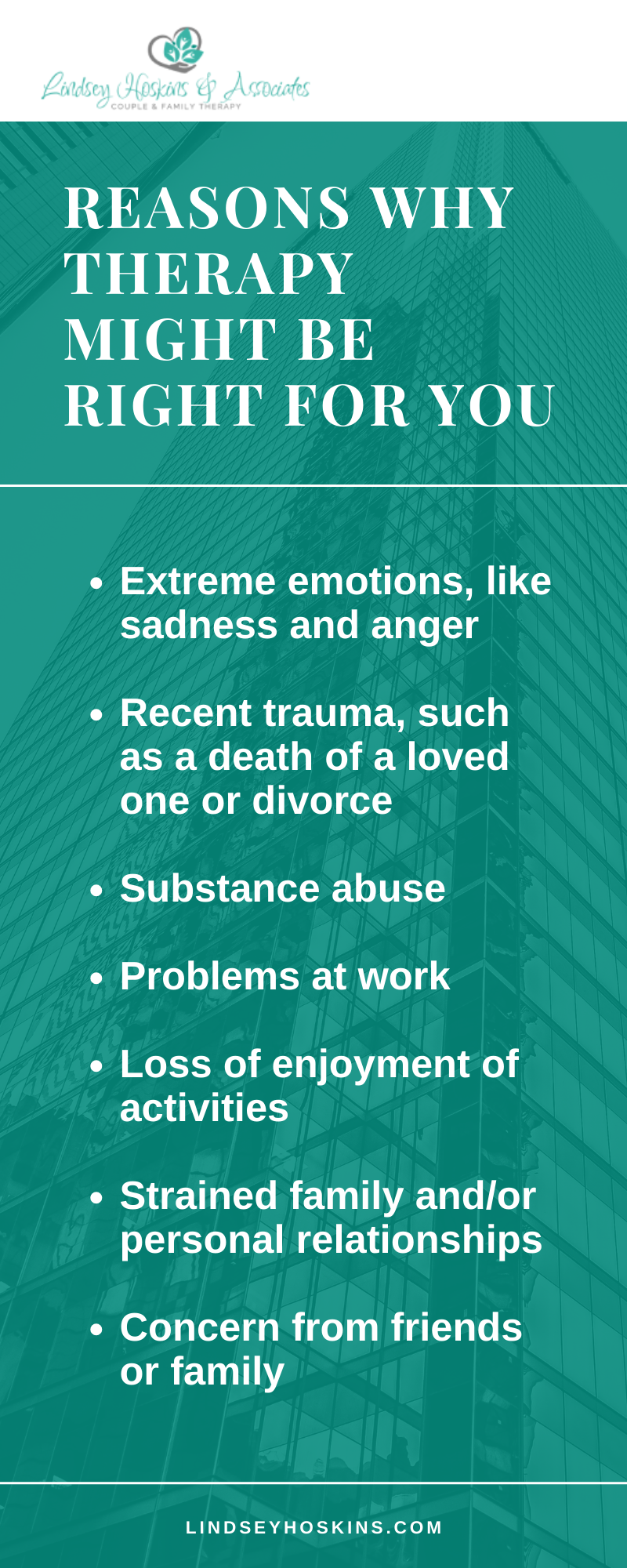
What Can Individual Therapy Help With?
One-on-one therapy can support you with a wide span of concerns, and you don’t have to arrive with a tidy explanation of the problem. Most people start by describing what hurts and let the rest take shape from there. We regularly help with:
- Anxiety, panic, and chronic worry
- Depression, burnout, and motivation that has run dry
- Grief, loss, and major life change
- The aftermath of trauma and difficult past experiences
- Self-understanding and lasting change, which often starts with practicing self-care in ways that actually stick
What Is the Therapy Process and Timeline?
Therapy tends to follow a rhythm, even though every person’s path differs:
- An intake session, where we learn your history and what you want to change
- Setting goals together, so the work has direction
- Ongoing sessions, where you practice and process between meetings
- Periodic reviews, where we check what’s helping and what isn’t
- Adjusting course as you grow, since needs shift over time
Timelines vary based on your goals and what you’re working through. Some people come for a focused stretch of a few months. Others stay longer, returning to deeper work once trust is established. There’s no single right answer, and we’ll revisit the plan with you rather than letting it run on autopilot.
What Should You Expect From Your First Session?
The first meeting is mostly about getting to know you. Here’s the general shape of it:
- A few intake forms to complete beforehand
- Space to tell your story at your own pace
- An early conversation about what you’d like to be different
- A mutual read on whether the fit feels right
Sessions usually run about fifty minutes. Fit matters more than people expect, and it’s worth paying attention to how you feel in the room with a clinician. You’re allowed to take your time deciding. If you want help getting the most from the process, a little preparation can make the most of your time together.
What Are Important Maryland Mental Health Resources?
Beyond our office, Maryland offers several ways to find support and confirm that any therapist you consider is properly credentialed. Doing a little homework before you commit is smart, not paranoid. A few resources worth knowing:
- The Maryland Board of Professional Counselors and Therapists lets you verify a clinician’s license before your first appointment
- The state’s Behavioral Health Administration oversees public mental health and substance use services
- Local community mental health centers and county health departments provide lower-cost care
- Medicaid and managed care organizations can connect eligible residents to covered services
- If you or someone you love is in crisis, the 988 Lifeline offers free, confidential support around the clock
- The SAMHSA National Helpline provides free treatment referrals for mental health and substance use concerns
Contact Lindsey Hoskins & Associates
Reaching out is the hardest part, and you’ve nearly done it. When you request an appointment or set up a complimentary phone consultation, we’ll talk briefly about what’s going on and which of our clinicians might be the right match for individual therapy in Bethesda, MD. There’s no pressure in that first call. We aim to respond promptly, and we’ll answer any questions you have about how we work. When you’re ready, contact us and we’ll take it from there.
Individual Therapy Statistics in Bethesda, MD
 Montgomery County ranks among the healthiest jurisdictions in the state, and provider availability is part of the reason. Availability and readiness are separate matters. Residents routinely wait a long while between recognizing a problem and scheduling an appointment for it. What the county and national data establish is the scale of the need and the level of access available to anyone considering individual therapy in Bethesda, MD.
- More than one in five American adults lived with a mental illness in 2022, roughly 59.3 million people, according to NIMH prevalence data
- Serious mental illness affected 6.0% of adults that year, with the highest rate, 11.6%, among those aged 18 to 25
- Any mental illness was reported by 26.4% of women compared with 19.7% of men
- Adults in Montgomery County report about 4.6 mentally unhealthy days per month, an age-adjusted measure tracked through County Health Rankings data
- Montgomery County health officials report a higher ratio of mental health providers per resident than both the Maryland and national averages
These figures describe populations rather than individuals. No percentage establishes whether individual counseling in Bethesda is warranted in your particular case. That assessment comes from a clinical conversation about what has changed in your daily functioning and how long it has persisted.
Questions to Ask Before Choosing a Bethesda Individual Therapist
The questions below are worth putting to any individual therapist in Bethesda, MD, whether you call our practice or someone else’s. Each one is designed to produce concrete information about training, method, and logistics rather than general reassurance.
- What license do you hold, and what does it cover? Maryland credentials marriage and family therapists, clinical social workers, and professional counselors separately, and the training behind each differs substantially. Every clinician at our practice is a fully licensed therapist or works under licensed supervision. Ask which license applies and what the clinician’s training concentrated on.
- How much of your caseload resembles my situation? A clinician who works with grief every week has developed methods that a generalist has not, and the same applies to trauma, panic, or marital conflict. Ask how often the clinician treats concerns like yours and in what settings that experience was built.
- What approach would you use with me, and why? You are not expected to know the difference between cognitive behavioral work and psychodynamic work. A clinician should be able to describe in plain terms which method they would apply to your situation and what it is meant to change.
- How will we know whether this is working? A clinician should be able to describe what improvement would look like against your stated goals, and should return to that question at intervals rather than letting sessions continue without review. Ask how often that review happens.
- What happens if we turn out not to be a match? Ask how the clinician handles referring a client elsewhere. A clear answer, including the names of colleagues they would suggest, indicates the question has been considered before it came up.
- Do you offer in-person sessions, video sessions, or both? We see clients in both formats. Confirm which a clinician offers, which states they are licensed to practice in for remote sessions, and how a change between formats is handled partway through treatment.
- What are your fees and payment policies? Confirm session rates, cancellation policies, and the documentation you would need for out-of-network reimbursement before the first appointment rather than after it.
- How do you handle confidentiality? A clinician should be able to explain the most frequently asked questions about the protections that apply and the narrow legal exceptions to them without being pressed for detail.
Two or three of these questions are enough for a first call. If narrowing the field feels overwhelming, it helps to choose the right therapist by prioritizing one or two concerns rather than weighing everything at once.
Bethesda, MD Individual Therapy FAQs
How do I know if I need individual therapy or couples therapy?
If the distress lives mainly inside you, start individually. If it lives between you and a partner, couples counseling is usually the better entry point. Plenty of people do both. We can help you sort out which makes sense during an initial conversation.
Do you offer a free consultation?
We offer a complimentary phone consultation before you commit to anything. It is a short call, not an intake session. You describe what brought you here, we answer questions about how we work, and together we consider which clinician might be the right match.
How long are individual therapy sessions?
Individual sessions generally run about fifty minutes. Frequency is usually weekly at the start, then tapers as you gain traction. Some people prefer every other week from the beginning, particularly when the work is focused on one specific goal rather than a broad pattern.
Do you take insurance?
Insurance and fee questions come up on nearly every first call, and we answer them directly. We will confirm current session rates, our standing with your plan, and the documentation you would need for out-of-network reimbursement before anything is scheduled.
How long will I be in therapy?
That depends on your goals. Some people come for a focused stretch of three or four months. Others stay a year or more, often going deeper once trust is established. Sessions taper as new patterns hold and you are able to sustain change without weekly support.
Can therapy help my relationships even if I come alone?
Yes. When one person changes how they respond within a relationship, the dynamics around them frequently change as well. We see this with individual clients whose partners or parents never attend a session. Much of that work involves regulating closeness and distance rather than waiting for the other person to move first.
Where is your office and is parking available?
Our office location is on Del Ray Avenue in Bethesda, MD, convenient to the Metro and to downtown garage parking. We also see clients across Maryland and Virginia by secure video when travel to the office is impractical.
What if I have never been in therapy before?
A substantial share of our clients have never worked with a clinician before. No preparation is required. You do not need to arrive with an organized account of the problem, and it is common for the first session to be the one in which a client works out what they wanted to say.
Do you work with anxiety and panic specifically?
We do, regularly. Racing thoughts, physical tension, avoidance that has quietly narrowed your life. If you want a sense of the approach before calling, our writing on managing fear and anxiety reflects how we think about it clinically.
Can I switch clinicians if the fit is wrong?
Yes, and telling us the fit is wrong is useful information rather than an imposition. We would prefer to transfer you to a colleague within the practice, or help you find a clinician elsewhere, than have you discontinue care altogether.
Important Resources for Bethesda Individual Therapy
What Does Mental Health Care Access Look Like in Bethesda?
Bethesda sits inside one of the better resourced health systems in Maryland, with a provider-to-resident ratio stronger than the state average and a hospital, research institutions, and county behavioral health programs within a few miles of one another. The practical effect is choice. Prospective clients here can compare several clinicians rather than accepting the first available opening, and doing so is worthwhile. Proximity to the National Institutes of Health also means an unusual concentration of clinicians trained in medical and research settings, a background that shapes how a trusted therapist approaches health-related stress, genetic risk, and the anxiety that follows a diagnosis.
What Are Important Local Resources for Bethesda Individual Therapy?
The organizations below serve Bethesda and the surrounding Montgomery County area. Listing them is not an endorsement, and none of them is affiliated with our practice.
- Montgomery County Crisis Center, 240-777-4000, offering free walk-in and telephone crisis services around the clock
- NAMI Montgomery County, 301-949-5852, a peer-run help line and support group network for individuals and families
- Suburban Hospital, 301-896-3100, the Johns Hopkins facility on Old Georgetown Road in Bethesda
- Montgomery County Hotline, 301-738-2255, a confidential listening and referral line staffed by trained volunteers
About Lindsey Hoskins & Associates
Lindsey Hoskins, PhD, LCMFT, founded this practice and still sees clients in it. Her doctoral work and clinical training prepared her to work with anyone who arrives committed to change, and she has built a group of licensed clinicians around that same standard. Her commentary on relationships and mental health has appeared in regional and national outlets. Clients working with an individual therapist here get a clinician who is supported by colleagues doing couples, family, and medical family work every day.
What Our Clients Say
⭐⭐⭐⭐⭐
“Dr. Hoskins is the most caring and genuine therapist. She always listens to everything I have to say and then provides helpful suggestions and direction to get through whatever I bring to her. She is always professional-but also comfortable to laugh with me. Dr. Hoskins has provided me with a positive means to work through family/work/social struggles. 5 stars for sure!”
Amy Thomas
Read more reviews on our Google Business Profile.
Additional Resources for Bethesda Individual Therapy
- How to Find a Therapist
- 6 Questions to Ask Your Potential Therapist
- Healing Trauma With a Therapist
- On Grief and Grieving
- Why Self-Care Is So Important
Contact Lindsey Hoskins & Associates
Starting individual therapy begins with a brief phone conversation. We will discuss what brought you to this point, answer your questions about fees and scheduling, and determine which of our clinicians is suited to the work you want to do. No obligation attaches to that call, and nothing needs to be scheduled at the end of it. We respond promptly to new inquiries. When you are ready for individual therapy in Bethesda, MD, contact us and we will take it from there.